Home Services Profit Margins in 2026: Why the Middle Is Getting Squeezed
Eric Engebretsen
•
October 1, 2026
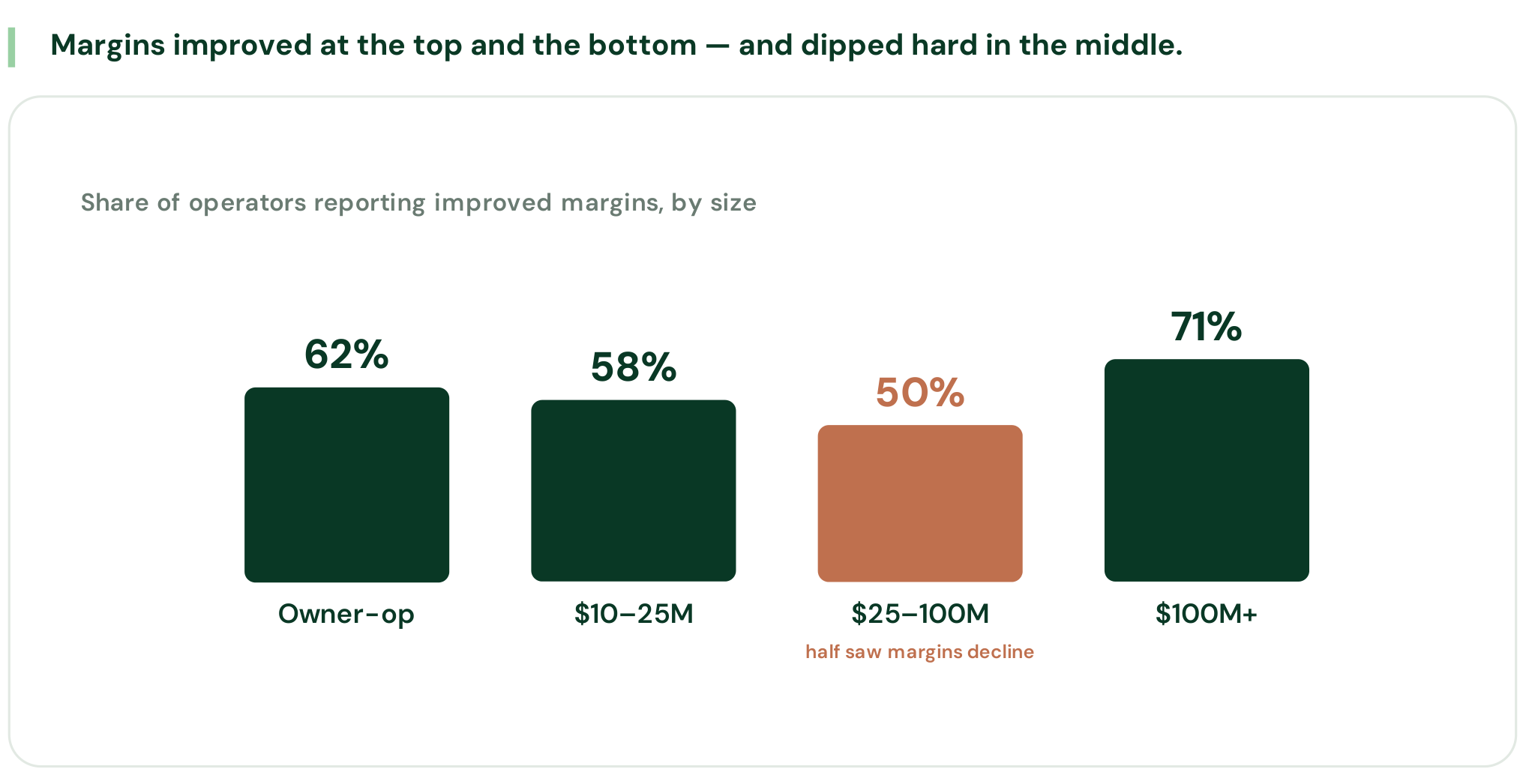
Most home services companies say their profit margins improved last year. In Hire Bloom's May 2026 survey of 32 operators across eight trades, 59% reported better margins and 78% expect higher revenue in 2026 than in 2025. The gains are not landing evenly. Owner-operators and $100M+ platforms are pulling ahead. The companies in between, roughly $25–100M in revenue, are the ones feeling the squeeze: half of them saw margins decline.
If you're an owner, general manager, or CFO trying to work out whether a tight year is a company problem or an industry problem, here's the short answer: it depends heavily on company size. We take a look at the margin benchmarks by trade, including a closer look at HVAC profit margins, the size pattern the survey turned up, the three pressures behind it, and what the operators with the healthiest margins are doing differently.
What is a good profit margin for a home services company?
A healthy net profit margin for a home services company is 10–20%, with the best-run operators in most trades reaching 18–25%. The industry average sits well below that. Benchmarks vary by trade, and the gap between "average" and "healthy" is mostly explained by two things: how much technician time is billable, and how much revenue recurs through maintenance agreements or service plans.
Trade
Typical net margin
Strong net margin
Source
HVAC
Industry average as low as 2–3%; residential service and replacement 10–20%
Net margin, not gross, is the number to watch. Gross margin shows whether jobs are priced right. Net margin shows whether the company is.
HVAC profit margins: what's good, what's average, and where the money leaks
HVAC has the widest documented spread between average and excellent performance. ServiceTitan's benchmarking puts the industry average as low as 2–3% net, calls 10–20% "healthy," and argues contractors should be aiming for 20%. Gross margin should run 50–55% across services. New-construction HVAC runs thinnest at 2–8% net, commercial service 8–15%, and residential service and replacement 10–20%.
Two levers explain most of the variance in HVAC company profit margins:
Put plainly, HVAC profit margins depend on how well people, systems, and pricing hold together under volume. That is also what tends to strain as a company grows, which is where the survey data picks up the story.
Is the home services industry struggling? Not exactly. The middle is.
The shape is a U. The smallest shops hold margin because the owner is still close to every job and every dollar. The largest platforms hold margin because they have scale, recurring-revenue mix, and pricing power. The $25–100M company has outgrown the first advantage and has not yet earned the second.
One caveat belongs here. The survey covers 32 operators recruited through professional outreach, and the sample skews large and private-equity-aware: 44% of respondents are above $100M in revenue and roofing makes up about a third of responses. "Half the middle saw margins decline" describes eight companies. It is a strong signal rather than a census, and the full methodology is worth reading before quoting it.
Why mid-sized home services companies are getting squeezed
Three pressures hit the $25–100M band at once. Each one costs margin.
1. Payroll scales faster than the systems that manage it
At $5M, the owner knows every technician by name and every job by address. At $40M there are dispatchers, CSRs, a quoting desk, a service manager, maybe a second branch, and the processes that held together at one location start to leak at three.
The survey shows this directly. Among operators under $25M, 50% name hiring technicians as their top people challenge. Above $25M, the top challenge flips to developing managers (45%). The hiring problem is solved and a leadership-depth problem takes its place, and leadership depth is expensive to build and slow to show up on a P&L.
Company size
Top people challenge
Share naming it
Under $25M
Hiring technicians — still fighting to fill the truck
50%
$25M and above
Developing managers — hiring is largely solved, leadership depth is not
45%
All operators
At least somewhat concerned about technician turnover
For a $40M independent, that can mean the competitor across town is a bolt-on with a national marketing budget, centralized call handling, and investors who can tolerate a thin margin for a few years while they take share. Most independents can't afford to match that. The best owners aren't rushing to sell, but they are running tighter operations to compete.
3. Technology spend without the discipline to run it
The third pressure is the least obvious. Operators are buying technology, and AI in particular, faster than they are building the training, documentation, and process to run it. In the survey, 91% of operators use AI, but the median operator has just two use cases, and the most common operational target is the inbound phone, the one place customers tolerate automation least. Spend without discipline shows up as margin leak, not margin gain. The next section walks through what the data says about AI and margins.
Does AI improve home services profit margins?
Not on its own. In the survey, the operators using AI most broadly were not the ones with the best margins. Among the 91% of operators who use AI, the smallest shops use it most widely: owner-operators average about 3.6 use cases and $10–25M shops about 3.8. The $100M+ operators average roughly 2.1 use cases, and private-equity-backed operators just 1.8. Yet the $100M+ band posted the strongest margin improvement of any group.
How AI is being used sharpens the picture. 55% of AI users describe their use as a general-purpose chatbot such as ChatGPT or Gemini open in a browser tab. Only 17% quote with it and 31% schedule with it. The most popular operational target is the inbound phone: 41% have pointed AI at call answering, because 78% of operators admit they are not very confident they capture and convert the calls coming in.
The phone is also where customers tolerate AI least. Hire Bloom's analysis of more than 10,000 home services reviews found that, among reviews mentioning AI, sentiment ran 69% negative, with the worst reactions on automated systems standing between a homeowner and an emergency. A lost emergency call never shows up as a technology cost. It shows up as margin that never arrived.
So the deliberate operators, disproportionately the large ones, are doing something less exciting: using AI where it is cheap to be wrong, and keeping trained people where it isn't. A sample of 32 cannot prove that restraint causes better margins; the report itself notes the two could simply be traveling alongside scale and pricing power. But the two are moving together, and the mechanism is plausible. HVAC operators in particular are working this out on the phone line, where AI answering services produce both quick savings and sharp customer backlash.
Is there really a technician shortage?
Yes, and it is a margin problem as much as a hiring problem. Industry estimates put the HVAC technician shortage at around 110,000, and the plumbing trade is forecast to be short roughly 550,000 plumbers by 2027. In the survey, 88% of operators are at least somewhat concerned about technician turnover; 44% are very concerned or call it their single biggest worry. Only four operators out of 32 said they were not worried at all.
The shortage changes shape with size. Under $25M, half of operators say hiring technicians is their top people challenge. Above $25M, the top challenge is developing managers. Both are labor problems with different price tags. A technician seat left open costs the revenue that truck would have run. A manager seat left open costs the efficiency of every truck under it.
There is a fair counterargument on any HVAC forum: the technician shortage is really a pay shortage, and companies that pay well don't have one. There is truth in it. Paying well requires margin to pay from, though, which brings the problem back to where the money is leaking in the first place.
What high-margin home services operators do differently
Asked where they plan to invest in the back office in 2026, operators gave two answers that tied for first: Training & SOPs (53%) and AI tools (53%). Recruiting came in at 38%, new software at 34%, office and facilities at 19%.
The two top investments are tied — people and AI, funded together.
The operators with momentum are not choosing between people and technology. They fund both, and they fund the unglamorous half — documentation, process, training — at the same rate as the exciting half.
Best Choice Roofing is the clearest example in the research. A top-five US residential roofer operating in two dozen states, it had every reason to automate its estimating team. Instead it ran the AI playbook, found that the custom agent alone could not close the gap, and added human capacity alongside the AI rather than betting on the agent. Insurance contingencies that go out with an estimate attached rose from under 25% to more than 80%, estimating throughput roughly tripled, and the company estimates it saves $478K a year. CEO Bryce Barnett frames every AI decision as a choice between whether AI can replace a job or make a person more efficient, and keeps landing on "and," not "or."
The pattern generalizes. Test the technology. Find the line where it stops adding value. Staff the other side of that line with people who are trained, documented, and managed well.
What this means for a squeezed operator
For a $25–100M company whose margins slipped last year, the data points away from the two most common explanations. Demand has not dried up, and the company is probably not behind on AI. More likely, the front and back office outgrew the systems and the people running them at the same moment a PE-backed competitor arrived with deeper pockets.
The evidence points to unglamorous fixes. Maintenance-plan penetration is the single biggest lever on net margin in ServiceTitan's data. Training and SOPs tied for the top investment priority among surveyed operators, and developing managers is the top people challenge above $25M. And since the costliest customer moments are the ones customers least want handled by AI, keeping trained people on those calls, and keeping those people from turning over, protects margin that no software line item can replace.
What is a good profit margin for a home services company?
add
A healthy net profit margin for a home services company is 10–20%, with top operators reaching 18–25%. Benchmarks vary by trade: HVAC averages can run as low as 2–3% net, plumbing typically lands at 5–12%, and pest control operators report EBITDA margins around 15–17%. The biggest drivers are billable technician utilization and the share of customers on recurring maintenance plans.
What is a good profit margin for an HVAC company?
add
ServiceTitan's benchmarks call 10–20% net a healthy HVAC profit margin and 20% the target, with highly optimized residential operators reaching 18–25%. Many HVAC contractors run far lower, as low as 2–3% net. Gross margin should sit around 50–55%. Utilization matters most: HVAC companies with over 85% billable technician time report 18–25% net, while those under 55% can run at a loss.
Why is the HVAC industry struggling in 2026?
add
Most of it isn't. Demand is strong and roughly three in four operators expect revenue growth in 2026. The strain is concentrated in mid-sized companies: half of $25–100M home services operators in Hire Bloom's 2026 survey saw margins decline. They face three pressures at once: payroll and complexity growing faster than systems, private-equity-backed competitors with deeper pockets, and technology spending not matched with training and process.
Is the home services industry growing?
add
Yes. US home services spending is estimated at roughly $842 billion for 2026. Jobber's 2026 Home Service Trends Report found 75% of businesses expecting revenue growth, and Hire Bloom's State of Home Services 2026 survey found 78%. With just over half of mortgaged homeowners holding rates below 4%, many are staying in place and spending on repairs, replacements, and upgrades rather than moving.
Does AI improve HVAC and home services profit margins?
add
Not automatically. In Hire Bloom's 2026 survey, the operators using AI most broadly were the smallest ones, while $100M+ operators used it least and improved margins most. Margin gains appeared where AI handled routine, low-stakes work and trained people handled high-stakes moments such as emergency calls, not where AI replaced the phone line outright.
.png)



.avif)
.png)