Do Customers Like AI Answering Services? What 125 Reviews Say
Eric Engebretsen
•
July 13, 2026
Do customers like AI answering services?
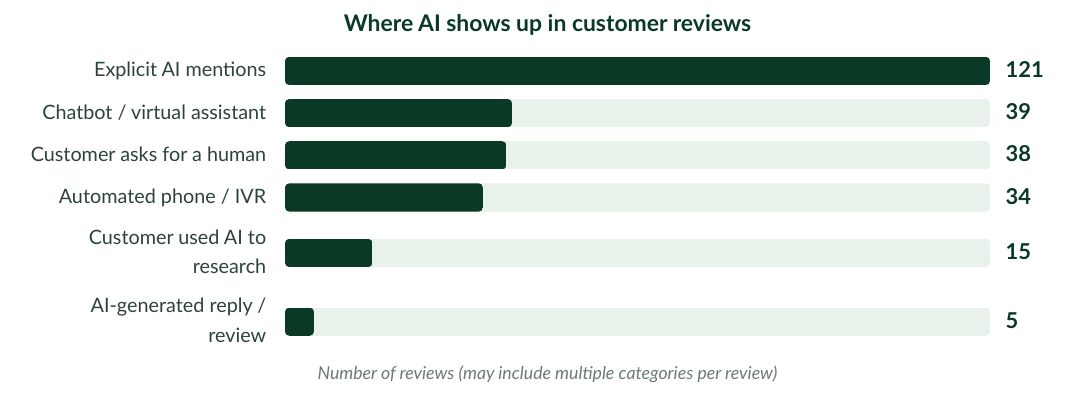
Mostly, no. We read 10,938 Google reviews of HVAC, pest control, plumbing, electrical and roofing companies. In the 125 reviews where customers commented on a company's AI answering service, chatbot or automated phone system, 78% were negative, 16% neutral and only 6% positive.
That doesn't mean customers reject AI outright. The 6% who praised it all described the same thing: the AI booked a slot after hours, and a person honored it. The complaints came from AI that booked appointments nobody could keep, receptionists customers could tell weren't human, and emergencies with no way to reach a person.
If you run a home services company and you're weighing an AI answering service, this post covers what your customers are writing about it, where it works, and where it costs you. The full methodology, cost analysis and operator interviews are in our research report, What 10,000 Customer Reviews Say About AI in Home Services.
Key findings
Finding
Number
Reviews that mention AI and are negative about it
78% of 125
Reviews that praise a company's AI
6% of 125
Five-star reviews praising a company for not using AI
13% of 125
US adults who trust AI "only a little" or "not at all" (Morning Consult, The AI Trust Report, May 2026)
63%
Source: Hire Bloom analysis of 10,938 Google reviews of US home services companies, most posted between 2024 and May 2026. 136 reviews mentioned AI; 11 that mentioned only the customer's own AI research tool were excluded, leaving 125.
What do customers complain about with AI answering services?
Customers bring up AI in two ways. Some name it directly: the chatbot, the AI receptionist, the phone tree. Others signal it by asking for a real person.
Three patterns account for almost all of the negative reviews. None of them is a problem with AI itself. Each comes from how the AI was set up and where it hands off to a person.
It books appointments that don't exist. This was the most damaging pattern in the data. The AI confirms a slot the company can't keep, whether it's the wrong service, the wrong time window, or a time a dispatcher has to call back and cancel the next day.
Customers can tell the "receptionist" is AI. Reviewers name the agents (Sara, Sarah, Chris, Hank, Kristin). That means the attempt to sound human failed, and customers remembered it.
Verification loops take longer than the hold time they replaced. Several reviewers described an AI asking for the same information three or four times, then passing them to a person who asked for it all again.
"The AI booked me for a time slot they didn't have, and I didn't have an appointment. An answering machine would have been better customer service." — HVAC customer · 1-star review
The second-order cost shows up in the hand-off. Zendesk's CX Trends research found 85% of customers have to re-explain their issue to a person after talking to AI, which pushes the cost of each human-handled call up rather than down.
When does an AI answering service do the most damage?
In emergencies. The reviews where customers canceled service, switched providers or warned others nearly all shared one feature: the customer had an urgent problem, and the AI stood between them and a person who could fix it.
The examples were specific. Ice storms. No water for five days. A multi-day plumbing failure where the only contact channel was an AI assistant. A $16,000 install that left tenants without heat.
"We spent $16k and have no heat or hot water. My tenants are now at risk of leaving. There is no emergency line to call because it is AI. We are desperate." — HVAC customer · 1-star review
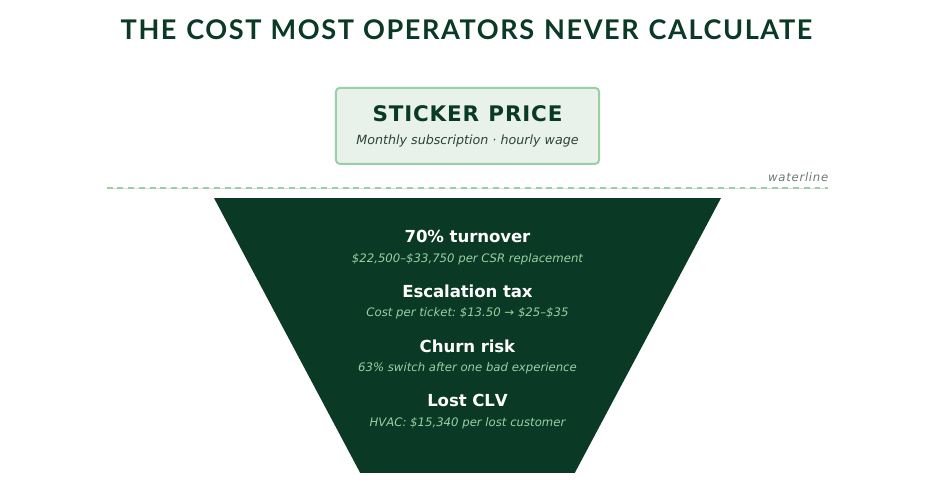
This is where the math on an AI answering service changes. A routine booking saved by AI is worth a few dollars. An emergency call it mishandles can cost a customer for life. ServiceTitan puts HVAC customer lifetime value at $15,340, and Zendesk found 63% of consumers switch after one bad experience.
The customers most likely to have that emergency are also the least likely to trust AI. Morning Consult found 48% of rural Americans and 48% of adults 65 and older don't trust AI at all, roughly double the rate among urban and Millennial respondents.
What do customers like about AI answering services?
One thing: the 2 a.m. booking that holds. Every review that praised a company's AI described an after-hours or overflow booking that a person honored the next morning.
"Huge fan of their AI phone reception active 24/7 for instant booking. Was able to call at 2 a.m. and the AI confirmed my appointment for 7 a.m." — HVAC customer · 5-star review
The flip side is just as clear. 13% of the AI-related reviews were five-star reviews that praised a company for not using AI: "the only ones who still have a human answering the phone." For those customers, a person on the line was the reason they chose the company.
Put together, the reviews point to a simple rule. Customers reward AI that takes a routine request off their plate when no one else is available. They punish AI that blocks them from a person when something has gone wrong.
Should you use an AI answering service?
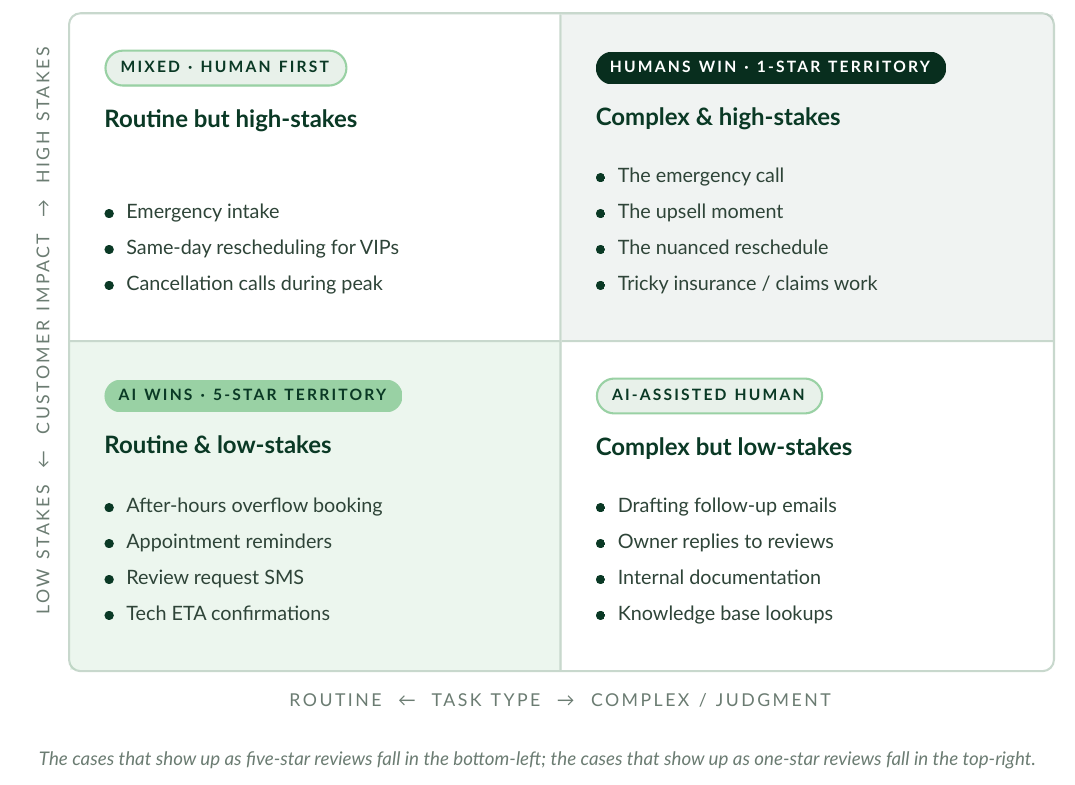
Yes, for the right calls. The operators getting this right aren't choosing between AI and people. They decide in advance which calls AI owns, which calls people own, and how the hand-off works. The reviews line up with two questions: how routine is the call, and how much is at stake for the customer if it goes wrong?
The five-star AI reviews all sit in the routine, low-stakes corner. The one-star reviews sit in the complex, high-stakes corner. That gives you a working rule: put AI on after-hours overflow, reminders and confirmations, and keep a trained person on emergencies, high-value reschedules and any call where the customer asks for one.
What it looks like in practice: Best Choice Roofing
Best Choice Roofing, the fourth-largest residential roofer in the US, spent the past year rebuilding its tech stack. CEO Bryce Barnett starts every AI decision with one question: can AI replace this job, or can it make a person more efficient? "It doesn't have to be 'or,'" he says. "It's always 'and.'"
His estimating team is the clearest example. Seven internal staff were handling 600–700 insurance contingency contracts a year, with estimates attached to fewer than 25%. A custom AI agent helped, but not enough. Adding 12–15 Hire Bloom team members alongside it took that to over 80%, more than three times the throughput, with an estimated $478K in annual savings.
"More and more people are realizing that AI is everywhere, and then they're also saying, 'I don't want that.' I actually want to deal with people." — Bryce Barnett, CEO, Best Choice Roofing
What an AI answering service really costs
An AI answering service looks cheaper on the invoice. The full cost includes the calls it escalates and the customers it loses.
This post covers the headline findings. The full report has the methodology, the review categories, the full cost model, commentary from operators at Peterman Brothers, Service Emperor HVAC and Best Choice Roofing, and the complete work-allocation framework.
Are AI answering services worth it for home services companies?
add
For routine, low-stakes calls, often yes. In our analysis of 125 home services reviews that mentioned AI, every positive review described an after-hours booking that a person honored the next day. For emergencies, complex reschedules and upsell calls, the reviews were overwhelmingly negative. Most operators get the best results by using AI for overflow and keeping trained people on high-stakes calls.
Can an AI answering service handle emergency calls?
add
It can take the call, but customers rarely rate it well. The most damaging reviews in our dataset came from emergencies, such as no heat or no water, where the AI gave a long window or blocked access to a person. If you use an AI answering service, give emergency callers a fast, clear path to a trained human.
Can customers tell when they're talking to an AI receptionist?
add
Often, yes. Reviewers in our dataset named AI receptionists by their personas (Sara, Chris, Hank, Kristin) and complained about them. Customers who realize they're talking to AI, especially when it was presented as a person, tend to remember it and mention it in reviews. Being upfront and offering a quick hand-off to a human reduces that backlash.
How much does an AI answering service cost?
add
Most AI answering services charge $200 to $2,000+ a month, or roughly $1 to $3 per resolved call. That sticker price leaves out escalation and churn. Zendesk found 85% of customers re-explain their issue to a human after AI, and HVAC customer lifetime value is about $15,340 (ServiceTitan), so one mishandled emergency can outweigh months of savings.
.png)

.avif)