HVAC Leaders Are Turning to AI for Answering Services — What's Working and What's Not
Eric Engebretsen
•
June 29, 2026
Updated October 2026 with findings from our HVAC reviews study.
Across home services, HVAC operators are pointing AI at the one place it's easiest to deploy and hardest to get right: the phone. The logic is sound. The phone is the leakiest, most expensive part of the business, so automating it looks like the obvious win.
The customers tell a different story.
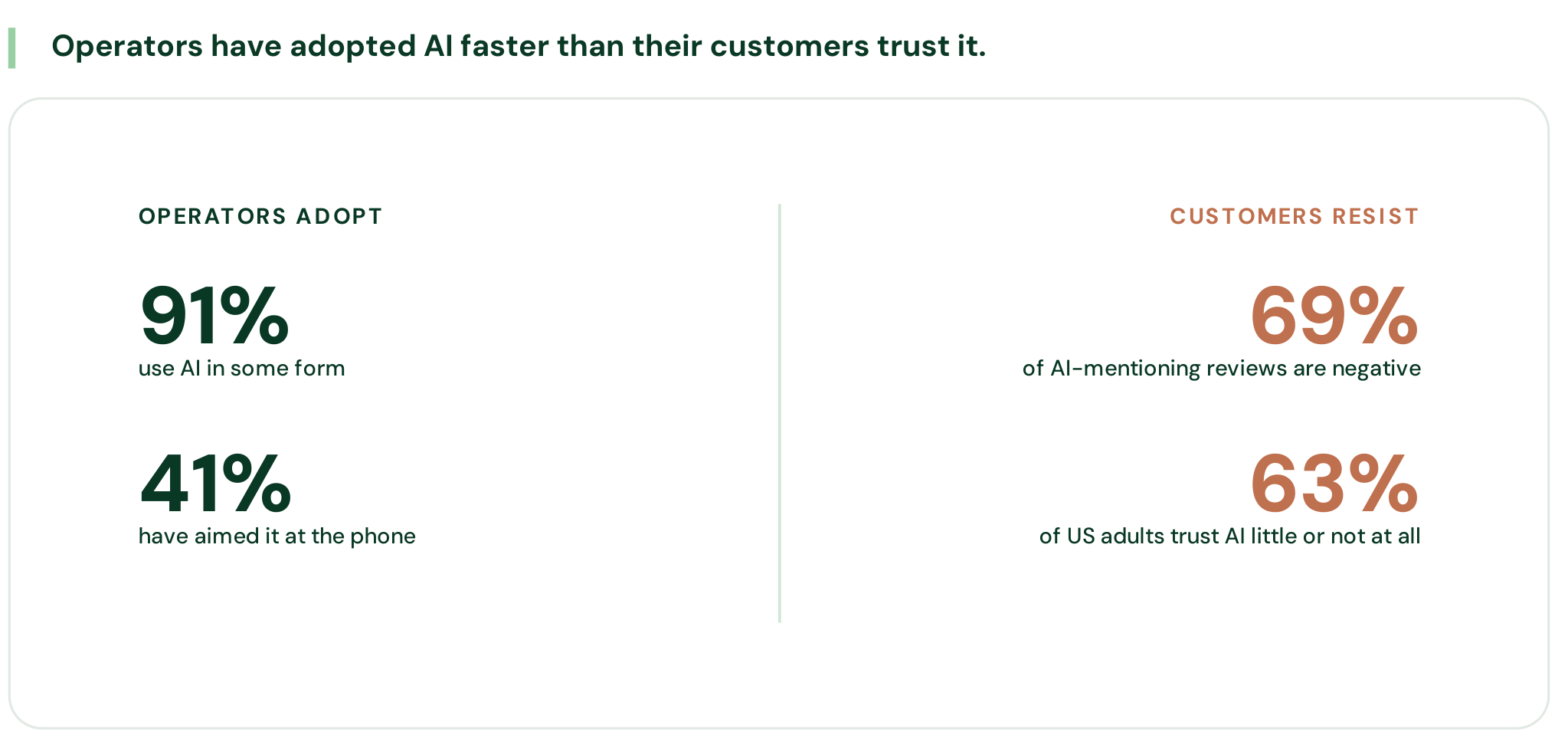
In a Hire Bloom analysis of more than 10,000 home services reviews, sentiment toward AI ran 69% negative. The worst reactions clustered on a single thing: an automated phone system standing between a panicking homeowner and a human being. An AI HVAC answering service is the easiest automation an operator can deploy — and, in the review data, the one customers punish hardest. What follows is a look at where AI actually belongs on the HVAC phone line, and where it's quietly costing operators the customers they already paid to win.
Everyone's aiming AI at the phone — because the phone is visibly bleeding
The instinct is rational. The phone is leaking.
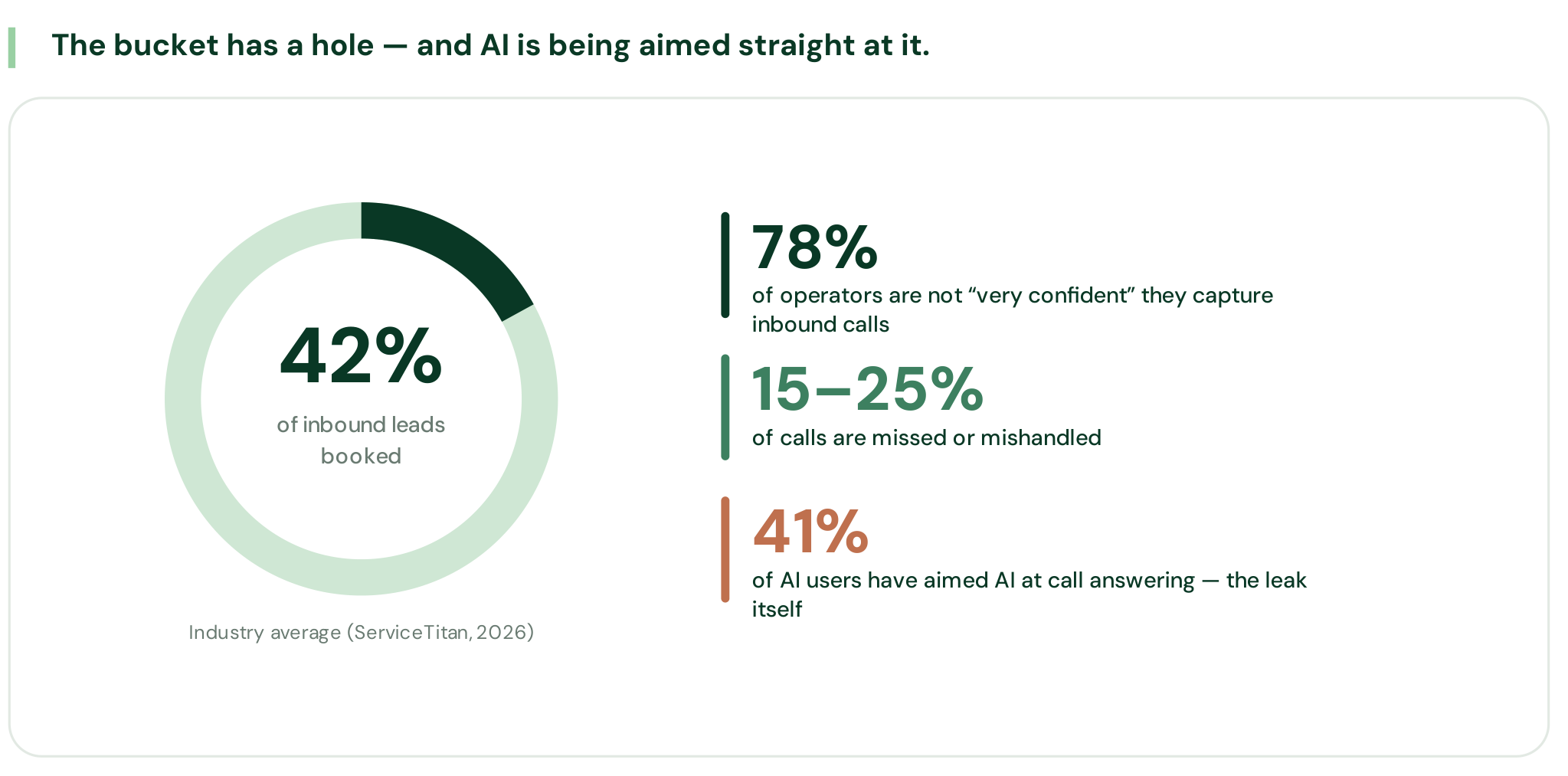
The average home services company books just 42% of its inbound call leads, and providers miss or mishandle an estimated 15–25% of calls (ServiceTitan, 2026). In Hire Bloom's 2026 Home Services Survey, 78% of operators said they're not "very confident" they capture and convert the calls coming in. The money is walking out the door, and everyone can hear it.
So operators reach for the most visible patch. 41% of AI users have aimed AI at call answering — more than aim it at scheduling (31%) or quoting (17%). It's the leakiest part of the business, and it's where the AI is going.
The problem is what's on the other end of that call.
The data on AI phone agents is brutal — across every trade
Precision matters here, because "customers hate AI" is both lazy and wrong. They don't hate AI. They hate bad AI, deployed at the worst possible moment.
When Hire Bloom pulled every review that explicitly mentioned AI, chatbots, virtual assistants, or automated phone systems, sentiment ran 69% negative, 28% positive, 3% neutral — and the pattern held across HVAC, pest control, plumbing, electrical, and roofing. Three failure patterns accounted for almost all the damage in an AI-run front office — in HVAC and every trade next to it:
AI-booked appointments that don't exist. The AI confirms an appointment the company can't actually keep: the wrong service, the wrong time window, or a slot dispatch has to call back and cancel the next day.
Named AI receptionists that customers can tell are AI. Customers identify these agents by name in their reviews, which means the humanization is failing, and it's memorable.
Verification loops that take longer than the hold time they replaced. The AI asks for the same information three or four times before the call reaches a human, who asks for it all again.
None of those are AI problems. They're architecture problems. But customers don't write one-star reviews about architecture. They write them about the night the furnace died.
"We spent $16k and have no heat or hot water. My tenants are now at risk of leaving. There is no emergency line to call because it is AI. We are desperate." — HVAC customer, 1-star review
AI is most dangerous in the exact moment HVAC lives or dies: the emergency
Here's the asymmetry that should worry any operator.
The inbound call is the single highest-stakes moment a home services customer has with a provider. No heat in an ice storm. A flooded mechanical room. A $16,000 install that left tenants in the cold. And it's the exact moment a customer has zero tolerance for a chatbot that gives them a four-hour window and ends the conversation.
Our HVAC reviews study makes the cost concrete. AI and phone-system frustration now shows up in HVAC reviews for the first time, in 39 of 5,956 reviews, and each mention drops the rating by an average of 1.72 stars. What happens next decides the review: 16 of those 39 customers still gave five stars, because a person eventually fixed the problem. The 14 one-star reviews are the ones where the bot stood between the customer and the fix.
And it compounds. A second 2026 landmine — "falsified work," where a tech claims a job was done when it wasn't — is rarer but far worse. The seven reviews that describe it average 1.29 stars, and every one also complains about incompetence. One review described an AI bot booking a follow-up visit for a fix that had never happened. The technician never showed.
The sticker price is the cheapest number on the page
The cost case for an AI phone agent always leads with the same math: a few dollars per resolution versus $35–$45 for a fully loaded human CSR. On paper it's decisive. In practice it almost never is, because three costs never make it onto the slide.
There's the escalation tax — 85% of customers re-explain everything to the human after the AI, so a $13.50 ticket becomes a $25–$35 ticket once AI absorbs the easy traffic. There's the churn cost — 63% of consumers switch after one bad experience, and HVAC customer lifetime value runs $15,340. One mishandled emergency call doesn't save an operator a few dollars; it can cost fifteen grand. As Gartner put it after surveying 350 enterprises deploying AI in May 2026: workforce reductions "create budget room. They do not create return."
It's the tension at the center of the whole debate: an AI phone agent can be cheaper per call and more expensive per customer at the same time.
The one win: an HVAC after hours answering service that hands off to a human
So is there a version of this that works? Yes — and it's specific.
When we read every positive AI review carefully, most of them praised a company for keeping a person on the phone. Only a small slice genuinely praised deployed AI, and every one of those clustered around a single move: AI books the after-hours or overflow slot, and a human honors it. The 2 a.m. call confirmed for 7 a.m. The Sunday-night booking that holds.
"Huge fan of their AI phone reception active 24/7 for instant booking. Was able to call at 2 a.m. and the AI confirmed my appointment for 7 a.m." — HVAC customer, 5-star review
That's the whole playbook for after-hours: let AI catch the routine overflow when no human is awake, and make sure a trained person owns the emergency, the upsell, and the nuanced reschedule. The operators winning in 2026 didn't pick a side. The biggest, best-margin operators in our survey actually use AI the least broadly — about 2.1 use cases versus 3.6–3.8 for the smallest shops. Restraint is tracking with results.
Best Choice Roofing is one of the clearest examples in the data. CEO Bryce Barnett ran the AI playbook on his estimating team, got partway, then added 12–15 Hire Bloom team members on top of a tighter software stack. Throughput on insurance contingencies went from under 25% to over 80% — more than 3x — with humans doing the parts AI couldn't. His rule: "It doesn't have to be 'or.' It's always 'and.'"
What the best answering service for HVAC company owners actually does in 2026
The cascade is the part most owners miss. In our HVAC reviews study, the technical complaints usually aren't only technical. When the office sends the wrong tech, the customer doesn't blame dispatch — they blame the tech standing in their kitchen. 12 of the 16 most damaging complaints are office, sales, or billing failures, not field problems. An AI bot bolted onto a broken front office just makes the cascade start faster and louder.
So the best front-office answering model for an HVAC business isn't a smarter bot or a bigger phone tree. It's a deliberate division of work between AI and people: AI on the genuinely routine, low-stakes calls — appointment reminders, ETA confirmations, after-hours overflow booking — and trained humans on every call where empathy, judgment, or money is on the line.
The Hire Bloom proof point
This is the gap we built Hire Bloom to fill. We embed dedicated, US-educated CSRs, dispatchers, and billing specialists — sourced from BYU-Pathway — directly into HVAC companies, alongside whatever AI stack you already run. Flat $13/hour. 70% first-year retention, compared with about 30% for US entry-level support roles. Live in 1–2 weeks. One HVAC operator, Cambridge Air, put it more warmly than our marketing ever could: "I don't know how you guys get such amazing talent for $13/hr… I am forever a missionary for Bloom."
We're not anti-AI. AI handles the bookings. Humans handle the frustrated customers. The team members we place are the second half of that sentence.
Hire Bloom publishes home-services research to help operators think clearly about staffing, AI, and the modern front office. Skip the resume pile. Meet pre-vetted CSRs who stay.
Frequently Asked Questions
Should an HVAC company use AI to answer the phone?
add
Use it narrowly. AI works well for after-hours overflow and routine confirmations — the only AI use case customers consistently reward in reviews. Keep a trained human on emergency calls, upsell conversations, and complex reschedules. Across 10,000+ reviews, 69% of AI mentions were negative, almost all tied to AI gatekeeping high-stakes calls.
Why do customers hate AI phone systems so much?
add
They don't hate AI — they hate being trapped by it during an emergency. The damage concentrates in three fixable failures: AI booking appointments that don't exist, named bots customers can tell are fake, and verification loops longer than the hold time they replaced. In HVAC reviews, an AI or phone-system complaint drops the rating by an average of 1.72 stars.
Is an AI answering service cheaper than hiring a CSR?
add
Only on the invoice. The sticker price ignores the escalation tax (85% of customers re-explain to a human anyway), and churn — 63% of consumers leave after one bad experience, and HVAC customer lifetime value is $15,340. One mishandled emergency can erase years of savings.
What's the best way to handle after-hours HVAC calls?
add
The pattern customers praise is simple: AI books the after-hours slot, and a human honors it the next morning. Pairing an after-hours booking tool with a real CSR who owns escalations captures the 2 a.m. lead without trapping the emergency caller in a loop.
.png)



.avif)